
After I earned my Bachelor’s degree in General Music, I continued at Vanguard University and began working on my Early Childhood Education units. During my coursework, I learned how formative the early years—birth to age eight—are in development. These years are the most impressionable because children learn through observation, imitation, and modeling. Modeling is vital for shaping learning, emotional responses, behaviors, and attitudes, essentially laying the foundation for social, emotional, and cognitive development.
As I reflected on this, the Lord brought to my attention that we are all His children, and we remain impacted by modeling even decades beyond those formative years. Modeling can shape new habits, skills, social norms, emotional responses, and even the beliefs of an adult. Scripture affirms this truth: “One generation shall commend your works to another, and shall declare your mighty acts” (Psalm 145:4). God designed faith to be lived out and passed on through modeling across generations.
I have personally experienced the power of modeling in both negative and positive ways. Years ago, I served on staff at a church where the environment was unhealthy and toxic. The pastoral team often used belittling “jokes,” gaslighting, and other inappropriate behaviors toward both staff and congregation members. At the time, I didn’t realize how their actions were affecting me. Eventually, I found myself battling low self-esteem, depression, and a very dry, desert-like season in my faith. It wasn’t until I left that church that I recognized how much their modeling had left an impression on me. Somewhere along the way, I had even begun to imitate some of those same habits—without fully realizing it. Scripture warns us of the weight our example carries: “But whoever causes one of these little ones who believe in me to sin, it would be better for him to have a great millstone fastened around his neck and to be drowned in the depth of the sea” (Matthew 18:6). Modeling matters—because it shapes souls.
On the other hand, I’ve also experienced the beauty of positive modeling. In 2023, I became connected with a Christian homeschool enrichment program. The coordinator and students there modeled love, a fire for God, and a heart for service. With every interaction, I found myself encouraged and prayed for. God’s presence was so strong among them that I felt naturally drawn in. Over time, I was blessed with friendships from the coordinator and teachers, and I noticed something shifting in me. The more time I spent with them, the more my love for God grew, the more I desired to serve, and the more the unhealthy habits I had developed during my earlier church experience began to fade.
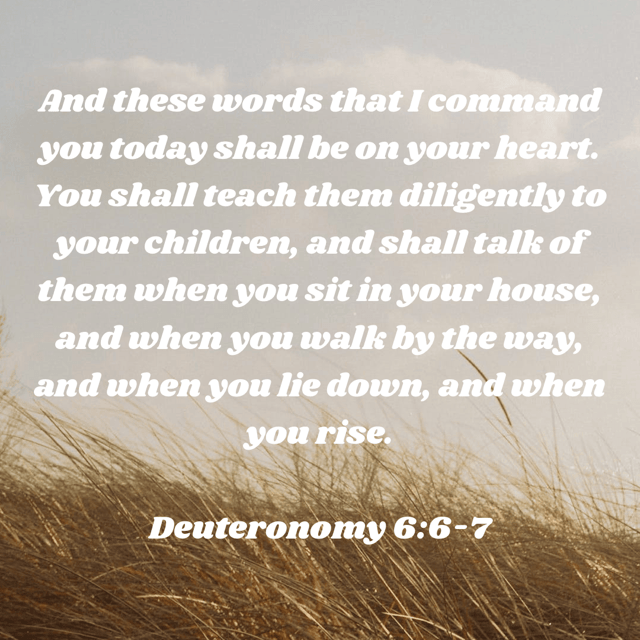
This is exactly how God designed discipleship to work. From the very beginning, Israel was instructed: “And these words that I command you today shall be on your heart. You shall teach them diligently to your children, and shall talk of them when you sit in your house, and when you walk by the way, and when you lie down, and when you rise” (Deuteronomy 6:6–7). The psalmist echoes this calling: “He established a testimony in Jacob and appointed a law in Israel, which he commanded our fathers to teach to their children, that the next generation might know them… so that they should set their hope in God” (Psalm 78:5–7). Modeling faith isn’t optional—it’s the very method God gave us to cultivate generational discipleship.
Jesus Himself modeled the Kingdom by elevating children as examples of faith: “Let the little children come to me; do not hinder them, for to such belongs the kingdom of God” (Mark 10:14). Likewise, Paul exhorted the church to live in ways that could be imitated: “What you have heard from me… entrust to faithful people who will be able to teach others also” (2 Timothy 2:2). Titus 2 gives a picture of this life-on-life discipleship where older men and women invest in the younger, modeling godliness in everyday life.
Through these experiences, I’ve learned that for modeling to be truly effective, it takes more than words—it takes time. Proverbs 20:29 reminds us that both the vigor of youth and the wisdom of the elderly are God-given gifts to the body of Christ. Paul encourages us to treat one another as family—older men as fathers, older women as mothers, younger men as brothers, and younger women as sisters (1 Timothy 5:1–2). True discipleship happens when we embrace this family identity, walking together in faith.
Ultimately, modeling requires presence. Whether it’s parents nurturing their children in the Lord (Ephesians 6:1–4, Colossians 3:20) or believers encouraging one another (Hebrews 10:24–25), discipleship happens in shared life. Even the smallest act—“giving a cup of cold water to one of these little ones” (Matthew 10:42)—is noticed by God.
Through both painful and beautiful seasons, I have come to see that discipleship is not primarily about books, programs, or quick answers. It is about presence, example, and shared life. Modeling Christ to one another is how faith deepens, bad habits are broken, and love grows strong.
My prayer is that we model our faith to those around us. May our words, actions, and attitudes point others to You, Lord, and may our lives plant seeds of love, hope, and discipleship for generations to come.

 From Seed to Vine
Leave a comment